Need a new mattress but don’t know which one to choose? When choosing, you may be surprised at how many types you can come across. A variety of materials are used for production, each with different properties. Thanks to the variety of manufacturing materials, you can choose a product that will match your exact requirements.
Choosing the right mattress in a nutshell
Before we start describing the specific steps involved in choosing the right mattress, let’s outline a few parameters to consider before you make your final choice.
Dimensions – remember that the mattress should always be 20-25 centimetres longer than your height. The width for a single mattress is 90 centimetres.
Height – the ideal height of a mattress is around 17 – 22 centimetres. Remember that the higher the mattress you get, the easier it will be to get up from it. However, about one quarter of it should be covered by the sides so that the mattress doesn’t slide off the bed.
Firmness – choose according to your weight, preferred sleep position and age.
Material – choose based on your preferences, needs and type of grate.
Carrying capacity – this is based on your weight, but it’s a good idea to allow for a margin.
It is advisable to test the mattress before buying it. Lay on it and lie in your favourite sleeping position for at least five minutes.
Which mattress material to choose?
There are a variety of manufacturing materials. Their properties will be explained in the following paragraphs.
Latex mattresses
Latex mattresses are among the softer mattresses and are usually available in very soft and soft (grade 1 and 2). Their key features include high elasticity, which makes them adapt well to the shape of the body. You can look forward to a long lifetime during which the mattresses retain their properties. The centre of the mattress is usually a slab of coir, PUR or HR foam, which gives the mattress its firmness.
Latex mattresses are not suitable for use in damp environments. Due to their lower breathability, they are not recommended for allergy sufferers or people who sweat excessively. The best base is a slatted grid. Due to their lack of breathability, they are not suitable for solid boards.
Foam mattresses
Foam mattresses are made of different types of foam, which can also be combined with each other. As a result, foam mattresses are available in different firmnesses and properties. Slatted mattresses are the most suitable base.
PUR foam mattress
Mattresses made of PUR foam or polyurethane are also known as foam mattresses. Their greatest advantage is their relatively low purchase price, but also good elasticity, dimensional stability and excellent resistance to compression. They are available in different degrees of hardness.
HR cold foam mattress
Cold foam differs from PUR foam mainly in the size of the pores, which are larger. This makes it more breathable, has higher elasticity and better dimensional stability. Air circulates sufficiently through the large pores, eliminating the occurrence of dust mites. A single mattress can be made up of several foams of different firmnesses, thus creating zoning. HR foam is most often combined with PUR or flax foam, resulting in better properties.
Lazy foam mattress
It is unique due to its ability to change hardness depending on body temperature. It softens on contact with the human body, so it adapts optimally to its curves. A mattress made of lazy foam is most often chosen by people who are sensitive to bruises, bedsores or suffer from back and joint pain. Find out all about anti-bedsore mattresses. Lazy foam provides the spine with sufficient support and has a positive effect on blood circulation. See if you are sleeping on a bedsore mattress.
Bio foam mattresses
It is a newer natural material that has gained its supporters mainly due to its positive impact on the ecology, as it is produced from natural oils. The mattress is more resistant to microbes, moulds and fungi, so choosing this mattress is also suitable for those with allergies. Characteristic features are elasticity, durability and good orthopaedic properties. They can be placed on most available mattresses.
Elliocell foam mattress
Elliocelli mattresses are filled with branded high-density PUR foam, which can reach up to 35 kilograms per cubic meter.
Sandwich mattresses
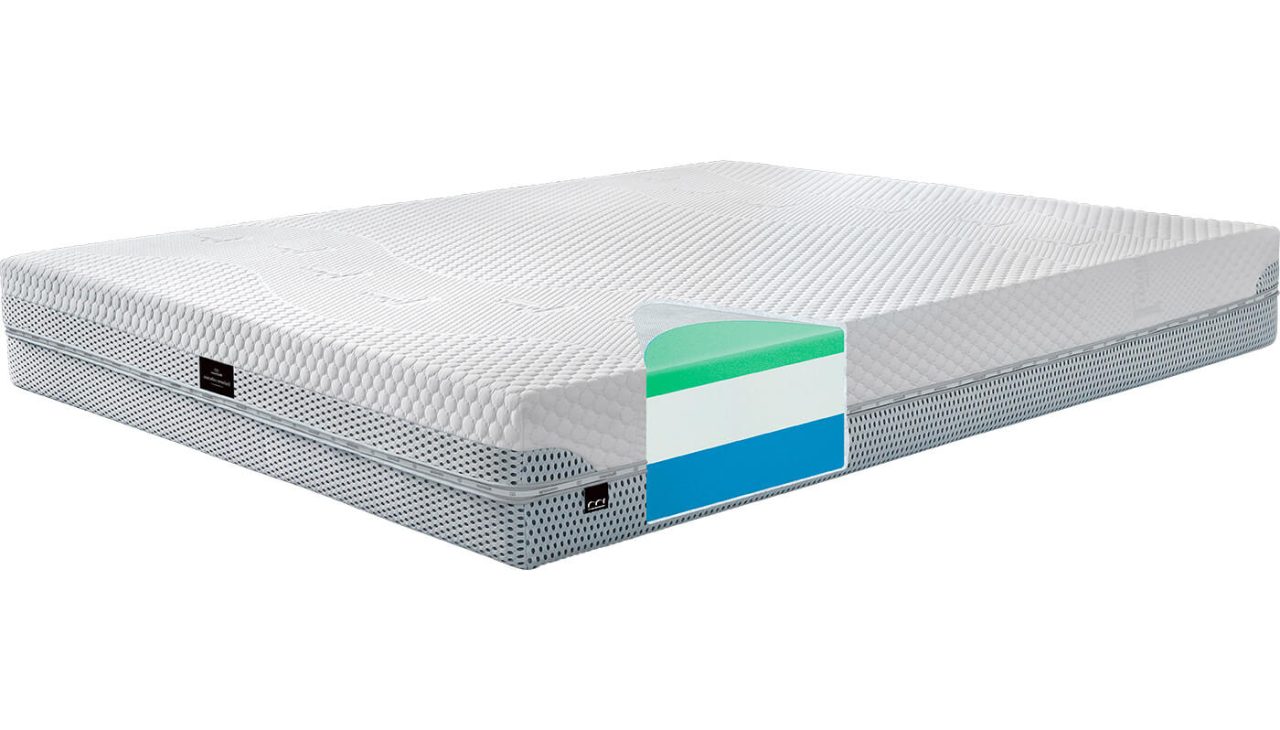
Sandwich mattresses are made of several layers of foams of different types and stiffnesses. The mattress is thus tailored to your exact requirements.
Medical and orthopaedic mattresses
Health mattresses and orthopaedic mattresses are not one and the same. An orthopaedic mattress is characterised by support for the skeletal system and correct weight distribution.
You can recognize a health product by the certification declaring it to be a health product. Certifications are awarded based on extensive testing depending on the health complication it is intended for (for example, it may be anti-allergic or work against bedsores). Another guideline is the reduced VAT rate, which for medical devices is not 21% but only 12%.
Lenka Hrušková from the State Institute for Drug Control states that if a person established in the Czech Republic wishes to market or import medical devices, he/she must register in the Register of Medical Devices (RZPRO) according to Section 26 of the ZoZP. After confirming the registration, the person must submit an application for notification of the medical device he/she is marketing or supplying according to Section 31 or Section 33 of the ZoZP through the RZPRO. Once approved, the Institute will issue a Medical Device Notification Decision, which can then be found at the Medical Device Listing. Once these requirements have been met, the mattress can carry the medical designation.
There is no Materasso medical mattress in the Czech Republic yet, but we are trying to get it included in the register of medical devices. In Slovakia the situation is different, several of our mattresses are registered as medical mattresses. Take a look at the Slovak database of medical devices. If you choose one of these mattresses, it will serve the elderly and those who have health problems and have to spend more time in bed well.
Spring mattresses
Spring mattresses have evolved significantly, so we can no longer compare them to the ones you slept on at grandma’s house. They are not suitable for manual or electrically adjustable mattresses. Thanks to new processing methods, spring mattresses can adapt perfectly to the shape of the body and the springs do not press against the surface. The core can be filled either with classic bonell springs or with pocket or micro pocket springs.
The Bonell springs are connected to each other by additional springs. This makes the sleeping surface durable and firm. The mattresses are harder than foam mattresses and are characterised by their high resistance to sagging.
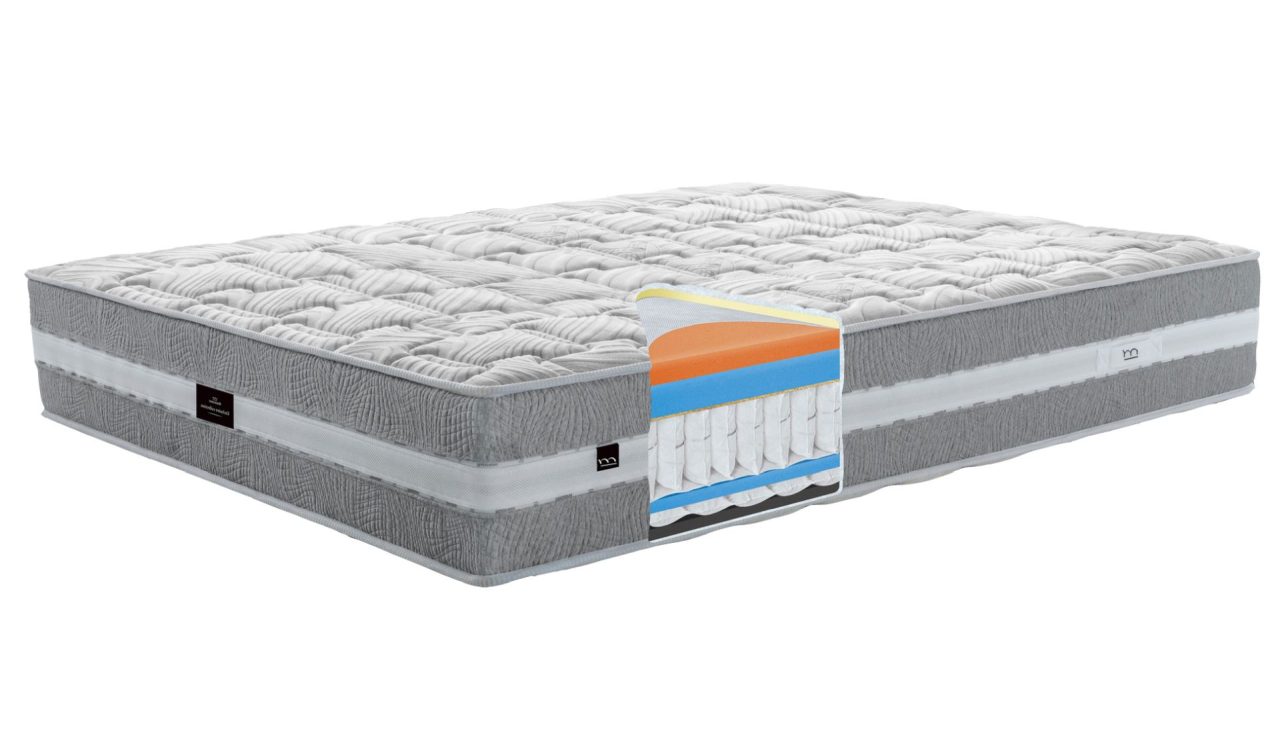
Bag mattresses are made up of several hundred springs, each of which is individually inserted into interconnected fabric sleeves. The mattresses thus distribute the weight better and provide sufficient support for the body. They effectively follow the shape of the body.
The microplate mattress is made up of several thousand springs that are sewn into their own textile casing. They adapt well to the shape of the body, unlike the two above, they are softer.
Image: Mattress with bag filling.
Hardness of the mattress
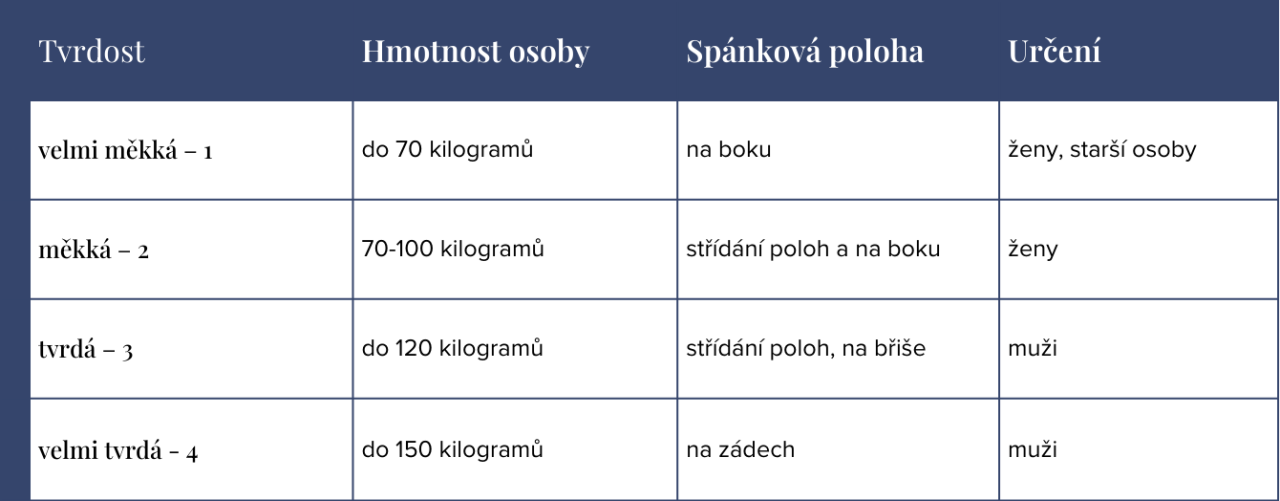
When choosing a mattress, you will most often come across four hardnesses ranging from soft to extra hard. Always take your weight into account when choosing. The maximum load capacity of the mattress should be about 5 kilograms above your weight.
The most commonly purchased mattresses are those marked 2 and 3, which satisfy the needs of most sleepers. Those with a lower weight can reach for soft mattresses, while those with a higher weight will choose from harder mattresses that provide sufficient support for the spine.
The data in the table are indicative only. When choosing a mattress, always evaluate your individual requirements and preferences. Image: Choose a mattress according to your preferences.
Very soft mattress
Latex or foam is most commonly used to make very soft mattresses. Their good properties include elasticity and adaptability. There are no bedsores when sleeping. This type of mattress should be chosen by older or less mobile people.
Soft mattress
The second degree of hardness is one of the most popular. You don’t sleep on either hard or too soft. A variety of materials are used for production. Polyurethane, spring, cold foam and sandwich mattresses are available. They are a good choice for anyone weighing less than 100 kilograms.
Hard mattress
Hardness number three is most often reached for by young people and people with higher weight. It provides sufficient support for the spine, but you should only opt for it if you prefer a firmer sleeping position. It is most commonly available in sandwich and spring designs.
Very hard
A mattress with this firmness is suitable for people with a higher weight. Men are more likely to reach for them than women. The production material is most often polyurethane foam with coconut fibre. These are the hardest mattresses on the market, so you should choose them when you actually require sleeping on a hard one.
Image: High-load mattresses made of several types of foam.
Combined hardnesses
There are also mattresses that combine the hardness. One side can be softer or harder than the other. Twin mattresses with dual firmness are also available. So each partner has the option of sleeping on a different level of firmness.
Zoning: different hardness for each part of the body
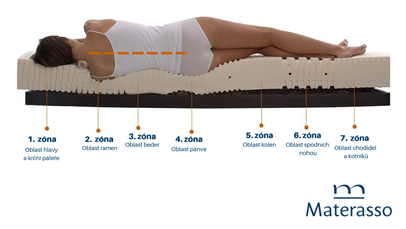
The main purpose of zoning is to provide sufficient support for each part of the body. The head, back and lower limbs require a different firmness. In general, the more zones, the better the quality of sleep. The highest number of zones on a mattress is seven:
zone – it is a raised zone in the neck area.
zone – a lightened zone located in the shoulder area.
zone – supports the back.
zone – this is the reinforced part for the hips.
zone – a lightened zone for the lower limbs.
zone – a softer zone designed for the calves.
zone – this is a medium-hard zone supporting the feet from the ankles downwards.
Breathability, an important parameter not only for allergy sufferers
A breathable mattress should be chosen not only by people suffering from breathing difficulties, but also by people who sweat excessively. If air does not circulate well through the mattress, it will become a breeding ground for bacteria, mould and dust mites.
Therefore, there should be cross-sections between the layers or at least special layers of natural and breathable materials, such as coconut fibre, horsehair, seagrass or agave.
Now you know how to choose the right mattress for you. We’ve also put together some useful tips for choosing other accessories:
Abychom poskytli co nejlepší služby, používáme k ukládání a/nebo přístupu k informacím o zařízení, technologie jako jsou soubory cookies. Souhlas s těmito technologiemi nám umožní zpracovávat údaje, jako je chování při procházení nebo jedinečná ID na tomto webu. Nesouhlas nebo odvolání souhlasu může nepříznivě ovlivnit určité vlastnosti a funkce.
Funkční
Always active
Technické uložení nebo přístup je nezbytně nutný pro legitimní účel umožnění použití konkrétní služby, kterou si odběratel nebo uživatel výslovně vyžádal, nebo pouze za účelem provedení přenosu sdělení prostřednictvím sítě elektronických komunikací.
Předvolby
Technické uložení nebo přístup je nezbytný pro legitimní účel ukládání preferencí, které nejsou požadovány odběratelem nebo uživatelem.
Statistiky
Technické uložení nebo přístup, který se používá výhradně pro statistické účely.Technické uložení nebo přístup, který se používá výhradně pro anonymní statistické účely. Bez předvolání, dobrovolného plnění ze strany vašeho Poskytovatele internetových služeb nebo dalších záznamů od třetí strany nelze informace, uložené nebo získané pouze pro tento účel, obvykle použít k vaší identifikaci.
Marketing
Technické uložení nebo přístup je nutný k vytvoření uživatelských profilů za účelem zasílání reklamy nebo sledování uživatele na webových stránkách nebo několika webových stránkách pro podobné marketingové účely.