If you’ve been waking up tired for a long time, or your partner has moved you out of the bedroom because of your snoring, you may be suffering from a sleep disorder. The sleep lab can help you. When should I make an appointment, what problems can they solve and how does the examination work?
Why is quality sleep so important?
During sleep, processes take place in your body that are important to your being. During sleep, there is a change in brain activity, which is accompanied by a change in consciousness, reduced sensitivity to external stimuli, relaxation of muscles, slowing of breathing and a reduction in body temperature and blood pressure.
Sleep eliminates fatigue. What all does it affect?
Concentration,
thinking,
deciding,
Memory,
spatial perception, etc.
You can stay awake for a few nights, but then you still fall asleep. Sleep is a basic biological process, just like the need to eat or drink.
Poor quality sleep takes a toll on your health
If you sleep poorly for a long time, you are setting yourself up for a whole host of health problems:
Immune system – the quality of your sleep has a direct impact on the function of your immune system, if you don’t get enough rest you will be more susceptible to a variety of infectious diseases.
Blood pressure – with chronic insomnia, cardiovascular disease can occur. Prolonged elevated blood pressure leads to damage to the arteries and narrowing of blood vessels. All of this can culminate in a heart attack or stroke.
Insulin production – people who are sleep deprived have higher blood sugar levels and are more prone to developing type 2 diabetes.
Body weight – due to lack of sleep, hormonal imbalance occurs, which leads to overeating. The consequence is weight gain.
The most common sleep disorders
Sleep disorders are not associated with any particular age. They can affect young children, adults and the elderly. However, different sleep disorders are more common at each age. In adolescents, people talk about delayed sleep phase, narcolepsy, which is excessive daytime sleepiness, or parasomnia. Older people are usually afflicted with sleep apnoea, where breathing stops during sleep.
Insomnia – Czech for insomnia. It is a disturbed falling asleep or sleep progression. You have difficulty falling asleep, or you wake up early and do not fall asleep. The cause of insomnia is long-term stress and irregular sleep patterns. If it has been bothering you for more than a month and the symptoms appear more often than 3 times a week, you need to seek medical help. It is probably chronic insomnia. Insomnia results in fatigue, malaise, irritability and impaired concentration.
Hypersomnia – Czech for excessive sleepiness. You sleep more than 12 hours a day and often fall asleep during various activities. The cause is poor sleep habits, but it can also be a symptom of encephalitis, depression or diabetes. It can also be a side effect of a medication.
Parasomnias – a set of sleep disorders that include sleepwalking, gnashing of teeth, night terrors and nightmares, and sleep paralysis.
Sleep apnoea is a breathing disorder. During sleep, breathing stops, which leads to more intense strain on the heart. Sleep apnoea is accompanied by snoring. You feel tired or have a dry throat in the morning.
Restless legs syndrome – occurs when lying down, especially when falling asleep, but can also wake you up at night. It is a neurological disorder. You have discomfort, throbbing or tingling in your legs.
Restless sleep as a consequence of inappropriate bedding
Irritability, restlessness, lack of concentration, impaired work or study performance. These can all be the result of poor quality sleep. Poor quality sleep is not necessarily caused by a sleep disorder. It could be:
a rickety and unstable bed frame,
a mattress that is too thin or unsuitable,
a grid that is not compatible with the mattress.
Remember also to use good quality blankets and pillows that should not cause allergies.
The bed frame has already done it
It may seem unlikely, but your bed frame also plays a part in how well you sleep. If there’s a creak with every turn or you feel an uncomfortable rocking motion, you’re probably not getting a good night’s sleep. You’ll subconsciously perceive noises, and the lack of a solid frame will make you worry that you’ll find yourself on the floor at any moment.
In addition, the bed frame can also cause allergies and other irritations. These ailments are most often associated with a laminate frame that has been treated with irritating chemicals.
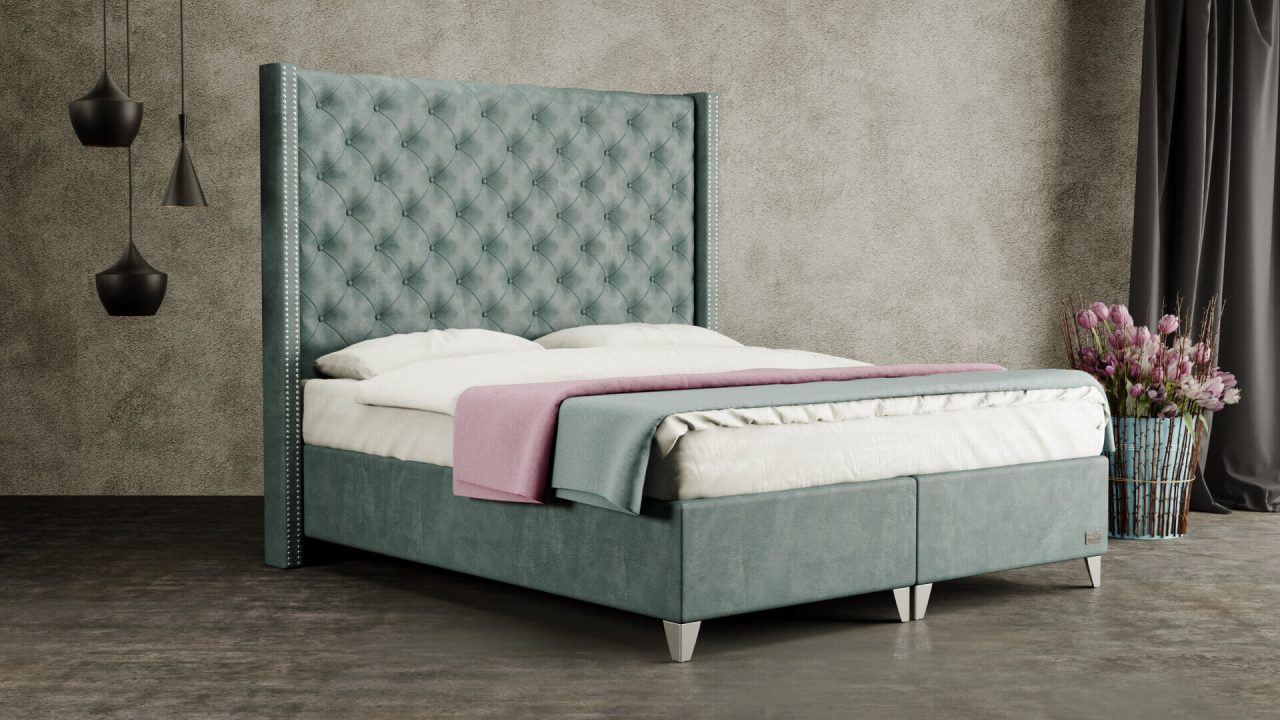
If you want to sleep on a comfortable and regal bed, reach for an American bed. It boasts a sturdy and solid frame, the bottom of which is filled with springs. These act as a grid. On top of the springs is a high mattress, which you choose according to your requirements for a good night’s sleep. The spring system is able to perfectly distribute the pressure exerted on the mattress, so that nothing presses on you while you sleep. A thin mattress topper is then placed on top of the sleeping mattress to adjust the firmness of the sleeping mattress, increase bed hygiene and extend the life of the main mattress.
The Boxspring bed therefore consists of a system of 3 mattresses that make sleeping an extraordinary experience:
spring mattress – located in the frame and replaces the grid,
the main mattress – it is placed on a spring mattress, you choose the height and its design according to your wishes,
thin mattress or topper – adjusts the firmness of the main mattress, making it even more comfortable, extends its life, increases bed hygiene.
Picture: boxspring bed with triple mattress system.
A mattress that is lying down
Do you get up in the morning with lower back pain or a stiff cervical spine? Do you wake up at night with tingling in your limbs? Do you have a full nose and red eyes when you wake up? Your mattress is probably to blame.
For hygiene reasons, it is recommended to replace the mattress every 7 years. Even with regular cleaning, a lot of dust and sweat will settle in the mattress in that time, creating a breeding ground for microbes and bacteria. These then cause unpleasant allergies and breathing problems.
Musculoskeletal pain or tingling in the limbs is probably related to the mattress being too thin or not suited to your body shape. You can tell if the mattress is sagging by seeing or feeling depressions in the mattress that do not return to their original position even when the pressure is released.
When choosing a new mattress, remember:
the length of the mattress – it should be about 25 cm longer than your height,
mattress height – the higher the mattress, the more comfortable the sleep, the ideal height starts at 20 cm,
the load capacity of the mattress – it should be about 5 kg higher than your weight,
manufacturing materials – they should match your health complications and overall requirements for quality sleep.
A grid that does not cooperate with the mattress
The main purpose of the mattress is to help distribute the pressure you apply to the mattress during sleep. If the mattress and the mattress get along, you don’t have to change sleeping positions unnecessarily often during sleep, there is no pressure anywhere and proper blood circulation is ensured. In addition, the mattress is able to “breathe” sufficiently. This means that it brings air to the mattress and allows moisture to escape freely. The mattress also retains its anatomical and stable surface thanks to the grid.
But if you sleep on an unsuitable mattress, you may suffer from a number of problems, such as frequent night wakings or painful rising.
Remember:
foam mattresses – belong on flexible slatted mattresses, not on fixed slatted and slab mattresses,
spring mattresses – belong on fixed slat and slab mattresses, not on reclining mattresses.
When to go to the sleep lab for a sleep study?
Either your doctor will refer you to a sleep lab or you can go yourself. This happens in cases when you get up in the morning unrefreshed, or your partner moves you out of the bedroom to the couch because you snore terribly. The cost of a sleep lab test varies. If you have a referral from your doctor, you usually don’t pay anything. For self-payers, the cost can be in the hundreds to thousands of crowns. The waiting time for an appointment is usually several weeks to months. During this time, it is recommended that you keep a “sleep diary” in which you record, for example:
what time you go to bed,
how many hours you sleep,
how many times you’ve woken up,
what it was like falling asleep, etc.
How is the sleep laboratory examination performed?
Your doctor will ask you about your sleeping habits, daily routine and bad habits before you get into bed and are connected to the measuring device. Sometimes sleep problems can be solved by adjusting your lifestyle and following sleep hygiene rules. If this doesn’t work, then the aforementioned device will reveal what sleep disorder is bothering you.
What questions can the doctor ask you?
Since when do you sleep badly?
What do you do to sleep better?
Are you in any psychotherapy?
When do you go and sleep and what is your daily routine?
What time and what did you last eat?
Do you drink and smoke?
Are you on medication? What kind?
Can you relax?
Are you under pressure and feeling stressed?
Do you have a family history of psychiatric illness?
Polygraphic and polysomnographic examination
If someone has trouble falling asleep in the sleep lab, they can get a special measuring device loaned to their home. It’s called a polygraph examination. The machine examines breathing movements of the chest and abdomen, airflow, blood oxygenation and motor activity in the lower limbs. However, it cannot assess brain activity, so it does not distinguish whether you are asleep or awake. And that’s what makes it important for diagnosing sleep disorders other than sleep apnea, for example.
Polysomnographic examination is more complex and is performed directly in the sleep laboratory. Brain activity is also detected during this measurement.
The nurse will attach sensing electrodes to your body:
brain activity,
muscle tension,
eye activity,
cardiac activity,
oxygen saturation of the blood,
chest and abdominal movements,
airflow through the nose.
In addition, there is also a camera and microphone installed in the room to detect, for example, whether you are talking in your sleep or moving around, sleepwalking or having night terrors.
How does the treatment work?
Once the test results are in, treatment for the sleep disorder can begin. For sleep apnoea, this may involve surgery or the use of a special ‘breathing’ machine that creates a vacuum so that you breathe properly in your sleep.
For insomnia, excessive sleepiness, sleepwalking, night terrors or talking in your sleep, treatment is more challenging. These are usually secondary manifestations of stress, psychological difficulties, the consequences of an accident or illness, or side effects of medication. Psychological support (relaxation techniques, learning to “control” sleep, etc.) is often used to induce healthy sleep.
List of sleep laboratories by region
There are dozens of sleep laboratories all over the Czech Republic. To simplify the selection, we have sorted them by region.
Prague and Central Bohemia Region
South Bohemia region
Pilsen and Karlovy Vary Region
Ústí nad Labem Region
Liberec Region
Hradec Králové Region
Pardubice Region
Vysočina Region
South Moravian Region
Olomouc Region
Zlín Region
Moravian-Silesian Region
Sleep centres – Prague and Central Bohemia Region
Sleep laboratory in Prague 2
Centre for Sleep and Wakefulness Disorders (Department of Neurology, 1st Faculty of Medicine, Charles University in Prague)
Our TIP: You can also participate in an 8-week group programme for insomnia patients. The program focuses on cognitive behavioral therapy. It is an alternative form of treatment designed for those who don’t just want to take medication for insomnia, but want to address their problem in a different way.
University Hospital Plzeň Edvarda Beneše 1128/13 305 99 Plzeň-Bory
We found out: The Breathing and Sleep Centre can be found in Hall 7 (ground floor, left). The ward has 6 beds for monitoring people with sleep and breathing problems.
Additional information:This is Hall A, 1st floor, elevator A1. The Sleep Laboratory deals with the diagnosis and treatment of sleep-disordered breathing. Sleep disorders and insomnia are not within its remit.
Sleep centres – Ústí nad Labem Region
Sleep laboratory in Ústí nad Labem
Krajská zdravotní, a.s. – Masaryk Hospital in Ústí nad Labem, o.z. Social care 3316 /12A 401 13 Ústí nad Labem
Disclaimer: They will help you with breathing problems while you sleep. The hospital offers diagnosis and treatment of sleep-disordered breathing, such as diagnosis and treatment of sleep apnea. Insomnia and other sleep disorders are treated in Hradec Kralove or Prague.
Website:https://www.nemlib.cz/orl/ E-mail(Regional Hospital Liberec): nemlib@nemlib.cz Telephone (directly to ENT outpatient department): +420 485 312 601
Website:https://www.fnusa.cz/ E-mail: info@fnusa.cz Telephone: +420 543 185 491, orders only by phone on Tuesdays from 8:30 to 11:00 and 12:00 to 13:00
Please note: Although this sleep lab is located in Building D, the pediatric pavilion, it examines not only pediatric patients, but also adult patients.
Abychom poskytli co nejlepší služby, používáme k ukládání a/nebo přístupu k informacím o zařízení, technologie jako jsou soubory cookies. Souhlas s těmito technologiemi nám umožní zpracovávat údaje, jako je chování při procházení nebo jedinečná ID na tomto webu. Nesouhlas nebo odvolání souhlasu může nepříznivě ovlivnit určité vlastnosti a funkce.
Funkční
Always active
Technické uložení nebo přístup je nezbytně nutný pro legitimní účel umožnění použití konkrétní služby, kterou si odběratel nebo uživatel výslovně vyžádal, nebo pouze za účelem provedení přenosu sdělení prostřednictvím sítě elektronických komunikací.
Předvolby
Technické uložení nebo přístup je nezbytný pro legitimní účel ukládání preferencí, které nejsou požadovány odběratelem nebo uživatelem.
Statistiky
Technické uložení nebo přístup, který se používá výhradně pro statistické účely.Technické uložení nebo přístup, který se používá výhradně pro anonymní statistické účely. Bez předvolání, dobrovolného plnění ze strany vašeho Poskytovatele internetových služeb nebo dalších záznamů od třetí strany nelze informace, uložené nebo získané pouze pro tento účel, obvykle použít k vaší identifikaci.
Marketing
Technické uložení nebo přístup je nutný k vytvoření uživatelských profilů za účelem zasílání reklamy nebo sledování uživatele na webových stránkách nebo několika webových stránkách pro podobné marketingové účely.