Latex mattresses are slowly but surely starting to win the hearts of many sleepers. Why? Because our planet doesn’t suffer when rubber is extracted and processed. Plus, it is a natural material that is hypoallergenic, making it resistant to mold and dust mites. The advantage of latex mattresses compared to foam mattresses is their higher durability. What else should you know about these natural mattresses?
Where does the substance called latex come from?
Bed mattresses are made from a variety of synthetic and natural materials. Latex is also known as natural rubber. It is obtained from the rubber tree. It is a milky substance, not sap, which is obtained by peeling the bark from the trees. It is often referred to as white gold. Rubber tree plantations can be found all over the world. Most can be found in Malaysia, Thailand, Indonesia and Cameroon.
Natural rubber is a substance that is renewable and sustainable. It can be harvested repeatedly from the same tree. It is not necessary to cut down the tree to obtain it, but, as we have written, only peel off the bark. This method of ‘extracting’ the rubber does not harm the tree. The sap can be extracted repeatedly from the tree for up to 30 years.
Did you know: rubber trees used for latex harvesting convert over 90 million tonnes of carbon dioxide into oxygen every year.
Image: the rubber called white gold.
Latex types are divided according to the processing method
When choosing a mattress for your bed, you will most often encounter just a simple latex label. But did you know that there are several types of latex that differ in their properties? In general, latex can be divided into two categories:
natural,
synthetic.
1. Natural latex
Natural latex is divided according to its processing into 2 well-known types, which are most often used for mattresses:
Dunlop,
Talalay.
The processing method, referred to as Dunlop, originated in the late 1920s. The foam is made from the collected rubber by mixing it with a small amount of non-toxic chemicals and then whipping it into a mass that resembles foam dough. This dough is poured into a mould and baked at 100 °C for a specified time. This produces a solid block of latex which is removed from the mould, cleaned and then re-baked to remove the moisture from the wet cleaning.
Talalay’s processing method is slightly younger than Dunlop’s. It began to be used in the 1940s and has a few extra production steps compared to the Dunlop method. Here too, the collected rubber is mixed with a small amount of non-toxic substances and poured into a mould. However, the mould is not filled completely, but only to a certain extent. The mould is then vacuum sealed, which leads to the formation of air bubbles. The mould is then quickly frozen to a temperature of -28 °C. The freezing and air bubbles result in a foam that is more airy than Dunlop. After freezing, the foam is transformed by carbon dioxide into a gel, which is then baked until solid.
Talalay latex is lighter, fluffier and has a more homogeneous structure due to a specific manufacturing process.
Dunlop type latex is firmer and therefore a good choice for sleepers with higher weight or those who like to sleep on their stomach. People who are lighter in weight and generally those who prefer to sleep on softer ground opt for Talalay foam.
Talalay and Dunlop production in a nutshell
In short, Dunlop latex is baked, while Talalay is vacuum sealed, frozen and then baked. Both Dunlop and Talalay contain 95% natural material and only 5% of the usually non-toxic chemicals needed to change the latex from a liquid to a solid.
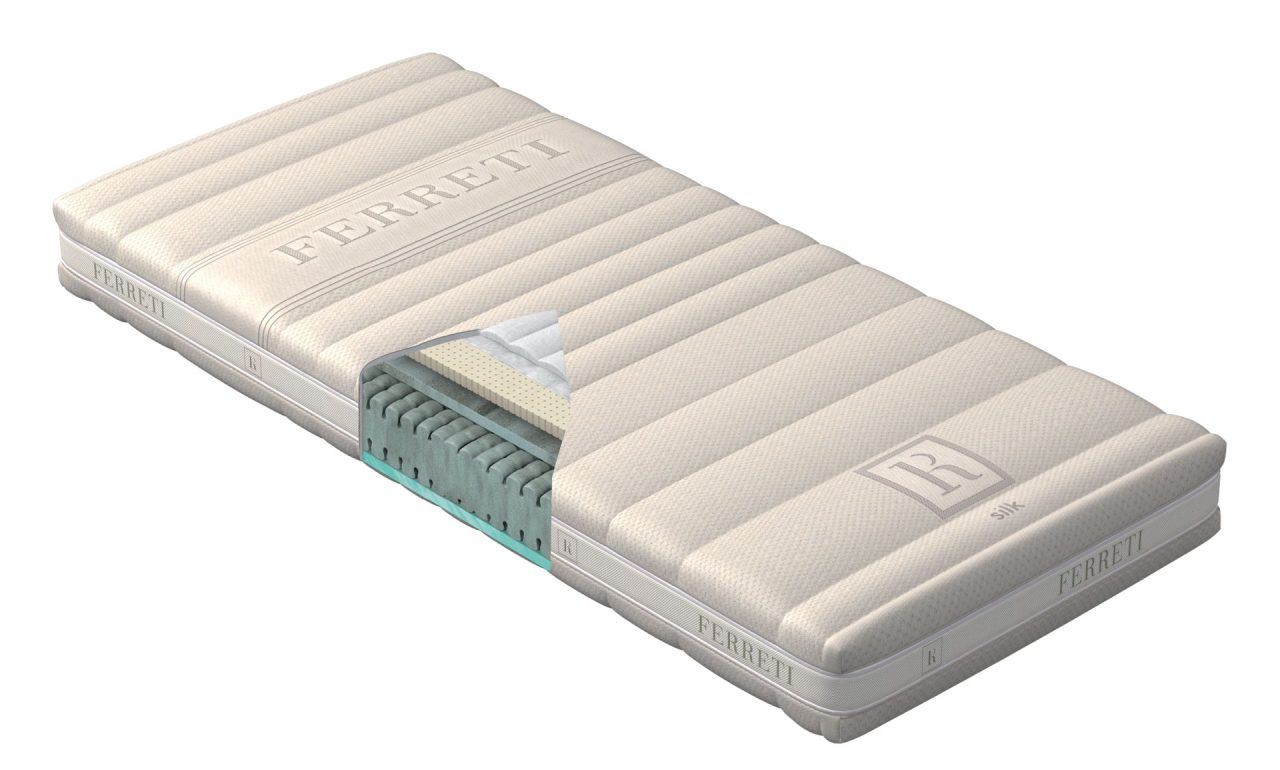
Picture: breathable mattress made of Talalay latex.
2. Synthetic latex
To produce synthetic latex, petrochemicals are used that are processed to mimic the feel of natural latex. It must be taken into account that synthetic latex is not as durable as natural latex.
What are the properties of natural latex mattresses?
Latex mattresses react quickly to changes in sleep position and are quite flexible, but the degree of flexibility depends on the type of latex and its strength. Latex mattresses, for example, are slightly firmer than memory foam mattresses, so they provide enough support for the body and can relieve pressure. You won’t ‘sink’ into latex like you do into memory foam.
Latex is a naturally porous or breathable material. Talalay latex is the most breathable. Thus, the mattress allows air to flow, is breathable and dissipates heat. You will not sweat while sleeping on latex.
Thanks to their natural origin, latex mattresses are resistant to mould and dust mites and are easy to clean. If you want a mattress that is as hygienic as possible, be sure to “dress” it in a mattress cover. You can also fit it with a mattress protector. Latex mattresses have a long service life.
Who is a latex mattress suitable for?
For allergy sufferers,
people who sweat more,
for those who prefer to sleep on firmer ground,
for everyone who cares about the environment.
Image: latex is resistant to dust mites.
Disadvantages of latex mattresses
Before you decide to get a latex mattress, get to know its disadvantages.
Higher purchase price – mattresses made of natural rubber are more expensive than mattresses made of synthetic fibres. In addition, specialised machinery and equipment is used in their manufacture, which increases the price of the mattress.
Higher weight – latex is generally a heavy material, so it can be harder to handle. Double mattresses are especially heavy in their entirety.
Rubber smell – new mattresses smell like rubber. However, this smell is harmless and will wear off in a few days. Before you put the mattress to bed, let it air out for a few days.
Mattress feel – sleeping on a latex mattress may not suit those who have been used to synthetic foam and spring mattresses. When you lie on a latex mattress, it feels like you are floating. You don’t “sink” into the mattress as deeply as you would with a memory foam mattress, for example.
Motion transfer – latex conducts movement, which means that if you sleep on one large 180 × 200 cm latex mattress with your partner, you will feel their movements. That’s why it’s best to put two separate 90 × 200 cm latex mattresses in your bed.
What about latex allergy?
Latex allergy is rare and affects only a negligible percentage of the population. It is said to be 1%. It is most common in healthcare workers who come into contact with latex gloves and other latex medical equipment.
Many people wonder whether sleeping on a latex mattress can cause a latex allergy. If you were to sleep night after night directly on latex that was not treated as recommended for mattresses, then obviously an allergy could occur. In most cases, however, this scenario is unlikely.
Most latex mattresses are suitable for allergy sufferers. A latex allergy is essentially an allergy to the proteins that latex contains. However, these proteins are no longer present in the latex used to make mattresses. During the manufacturing process, which involves washing and baking, the protein content of the fabric is significantly eliminated. In addition, latex mattresses contain other manufacturing materials such as wool or cotton, so you hardly come into contact with the latex itself. However, if you suffer from a serious latex allergy, it may be best for you to reach for a different kind of mattress.
At Materasso , we can make you a tailor-made mattress. Just choose whether you want a latex mattress with dimensions of 90 × 200, 180 × 200, 160 × 200, 140 × 200 cm or another atypical size. In addition, you can also choose a suitable mattress cover with various treatments that will, for example, help you fall asleep faster or protect you from dust mites.
Sleep in a perfectly hygienic bed. Latex mattresses are resistant to bacteria and dust mites, and their production does not pollute the planet.
Abychom poskytli co nejlepší služby, používáme k ukládání a/nebo přístupu k informacím o zařízení, technologie jako jsou soubory cookies. Souhlas s těmito technologiemi nám umožní zpracovávat údaje, jako je chování při procházení nebo jedinečná ID na tomto webu. Nesouhlas nebo odvolání souhlasu může nepříznivě ovlivnit určité vlastnosti a funkce.
Funkční
Always active
Technické uložení nebo přístup je nezbytně nutný pro legitimní účel umožnění použití konkrétní služby, kterou si odběratel nebo uživatel výslovně vyžádal, nebo pouze za účelem provedení přenosu sdělení prostřednictvím sítě elektronických komunikací.
Předvolby
Technické uložení nebo přístup je nezbytný pro legitimní účel ukládání preferencí, které nejsou požadovány odběratelem nebo uživatelem.
Statistiky
Technické uložení nebo přístup, který se používá výhradně pro statistické účely.Technické uložení nebo přístup, který se používá výhradně pro anonymní statistické účely. Bez předvolání, dobrovolného plnění ze strany vašeho Poskytovatele internetových služeb nebo dalších záznamů od třetí strany nelze informace, uložené nebo získané pouze pro tento účel, obvykle použít k vaší identifikaci.
Marketing
Technické uložení nebo přístup je nutný k vytvoření uživatelských profilů za účelem zasílání reklamy nebo sledování uživatele na webových stránkách nebo několika webových stránkách pro podobné marketingové účely.